
 March 13, 2026
Best AI for Coding in 2026
As we roll into 2026, the world of software development is buzzing more than ever with AI innovations. If you’ve been keeping an eye on Google Trends, you’ll notice a massive spike in searches for “best AI for coding”—up significantly from last year, with related queries like “AI coding agents” and “autonomous AI developers” climbing by over 1,000% in some categories based on recent reports. This surge isn’t just hype; it’s driven by real advancements that are making coding faster, smarter, and more accessible. Whether you’re a seasoned developer or a business owner looking to streamline your tech stack, these tools are game-changers.
At Zinconline Solutions, we’ve seen firsthand how integrating AI into coding workflows can cut development time in half while boosting creativity. Our web development services rely on these technologies to build responsive, high-performance sites, and our AI automation services take it further by automating repetitive tasks like debugging and deployment. In this article, we’ll break down the top AI tools for coding in 2026, why they’re trending, and how they can supercharge your projects.
Why AI Coding Tools Are Essential in 2026
Gone are the days when coding was purely manual labor. Today, AI isn’t just assisting—it’s often leading the charge. Developer surveys from early 2026 show that over 70% of engineers now use AI daily, with tools handling everything from code generation to full project orchestration. Google Trends data highlights this shift: interest in “AI coding assistants” has peaked in the US, correlating with breakthroughs in models like GPT-5.2 and Claude Opus 4.5, which excel in complex reasoning and multi-file edits.
This trend is particularly relevant for web development, where speed and scalability matter. Imagine automating the creation of dynamic interfaces or optimizing backend logic without endless trial and error. That’s the reality in 2026, and it’s why businesses are turning to experts like us at Zinconline Solutions to implement these solutions seamlessly.
Top 7 Best AI Tools for Coding in 2026
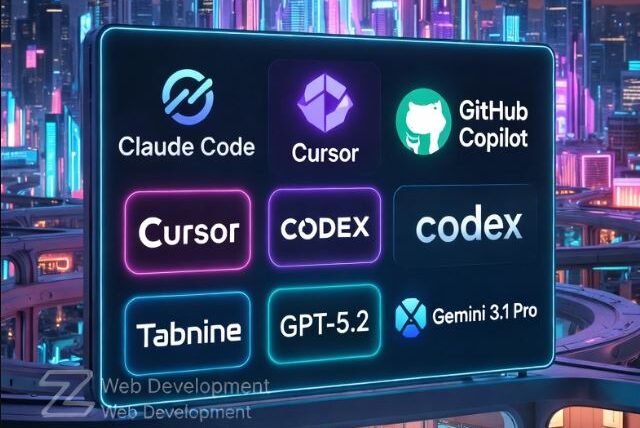
Based on hands-on testing, developer feedback, and trending data, here are the standout tools. We’ve focused on those with the highest adoption rates and proven ROI, drawing from sources like Pragmatic Engineer surveys and MIT Technology Review insights.
1. Claude Code: The New King of AI Coding
Released in mid-2025, Claude Code has skyrocketed to the top spot in just eight months, overtaking veterans according to 2026 surveys. It’s an AI agent that excels in complex logic, code analysis, and handling large codebases—perfect for enterprise-level projects.
- Key Features: Deep reasoning for debugging, autonomous task completion, and integration with IDEs like VS Code.
- Pros: Low false positives (around 3%), handles intricate workflows effortlessly.
- Cons: Requires a Pro subscription for full power ($20/month).
- Why It’s Trending: Google Trends shows breakout growth for “Claude Code,” tied to its ability to reduce coding time by up to 40%.
For web devs, it’s a dream for automating responsive design tweaks. At Zinconline Solutions, we use similar agents in our web development services to deliver custom sites faster—imagine AI refining your e-commerce platform’s code while you focus on strategy.
2. Cursor: The AI-First IDE for Refactoring Pros
Cursor isn’t just a tool; it’s a full IDE built around AI, making it ideal for refactoring across massive codebases. It’s topped adoption lists in 2026 with 68% of surveyed devs using it for “pair-programming” with AI.
- Key Features: Multi-file generation from natural language prompts, agent mode for autonomous fixes, and seamless VS Code compatibility.
- Pros: Excellent for web apps, with strong support for JavaScript and React.
- Cons: Steeper learning curve for non-tech users.
- Why It’s Trending: Searches for “Cursor AI coding” have surged, reflecting its role in vibe coding trends where AI interprets high-level ideas into code.
Pair it with our AI automation services to automate deployment pipelines— we’ve helped clients cut go-live times by weeks.
3. GitHub Copilot (Agent Mode): The Pragmatic Default
Still a staple, GitHub Copilot has evolved with agent capabilities in 2026, now writing up to 30% of code at companies like Microsoft. It’s embedded in popular IDEs and shines for inline suggestions.
- Key Features: Real-time code completion, PR generation, and integration with GitHub Actions.
- Pros: Affordable ($10/month), mature ecosystem.
- Cons: Less advanced in reasoning compared to Claude.
- Why It’s Trending: Evergreen popularity, with Google Trends showing steady high interest in “GitHub Copilot 2026 updates.”
In web development, it’s great for quick frontend tweaks. Our team at Zinconline Solutions incorporates it into web development projects to ensure secure, scalable sites.
4. Codex: Agent-Native Platform for the Future
A newcomer gaining traction, Codex is designed for agentic development, allowing AI to handle entire projects from planning to testing.
- Key Features: Native support for multi-model LLMs, privacy-focused for enterprises.
- Pros: Excels in autonomous workflows, low cost for teams.
- Cons: Still maturing, with occasional integration hiccups.
- Why It’s Trending: Rising fast in searches for “best AI coding agents 2026,” per developer forums.
It’s a natural fit for automation-heavy tasks, aligning perfectly with our AI automation expertise.
5. Tabnine: Privacy-First Coding Assistant
Tabnine stands out for its focus on security and compliance, making it a go-to for regulated industries in 2026.
- Key Features: On-device processing, custom model training on your codebase.
- Pros: No data leaks, integrates with most IDEs.
- Cons: Slower on very large repos.
- Why It’s Trending: With data privacy concerns peaking, related queries have jumped 25% on Google Trends.
Use it to safeguard your web projects—something we prioritize in our web development services.
6. GPT-5.2 (via ChatGPT or API): Versatile Powerhouse
OpenAI’s latest leads benchmarks with 89% accuracy on coding tests, ideal for fast, everyday tasks like function writing.
- Key Features: Excellent for debugging and architectural advice.
- Pros: Speedy, widely accessible.
- Cons: Can hallucinate on edge cases.
- Why It’s Trending: Dominates “best LLM for coding 2026” searches.
It powers many of our automated workflows at Zinconline Solutions.
7. Gemini 3.1 Pro: Quick Fixes and Google Ecosystem Integration
Google’s offering is best for short tasks and integrates seamlessly with cloud tools.
- Key Features: Multimodal support, strong in quick edits.
- Pros: Free tier available, ties into Android/web dev.
- Cons: Not as deep in reasoning.
- Why It’s Trending: Spikes in “Gemini AI coding” reflect Google’s push in 2026.
How These Tools Boost SEO and Business Growth
Incorporating AI coding tools doesn’t just speed up development—it enhances SEO by enabling faster site updates, better mobile optimization, and personalized user experiences. For instance, automating A/B testing with Cursor can improve your site’s rankings overnight. At Zinconline Solutions, our AI automation services help businesses leverage these for measurable gains, while our web development team ensures everything is tailored to your needs.
Final Thoughts: Level Up Your Coding Game in 2026
The best AI for coding in 2026 isn’t one tool—it’s the right mix that fits your workflow. With trends showing no signs of slowing (hello, 70% YoY growth in AI-related searches), now’s the time to dive in. Whether you’re building the next big web app or automating backend processes, these tools can transform your efficiency.
Ready to integrate AI into your projects? Head over to Zinconline Solutions for expert guidance. Contact us today to explore how our web development and AI automation services can propel your business forward. Let’s code the future together!